
Connecting You to the Latest News,
Study Tips, and Academic Resources
AP Statistics 5-Point Tutoring: Master the College Board Question Bank + Probability Score-Boosting Strategies!
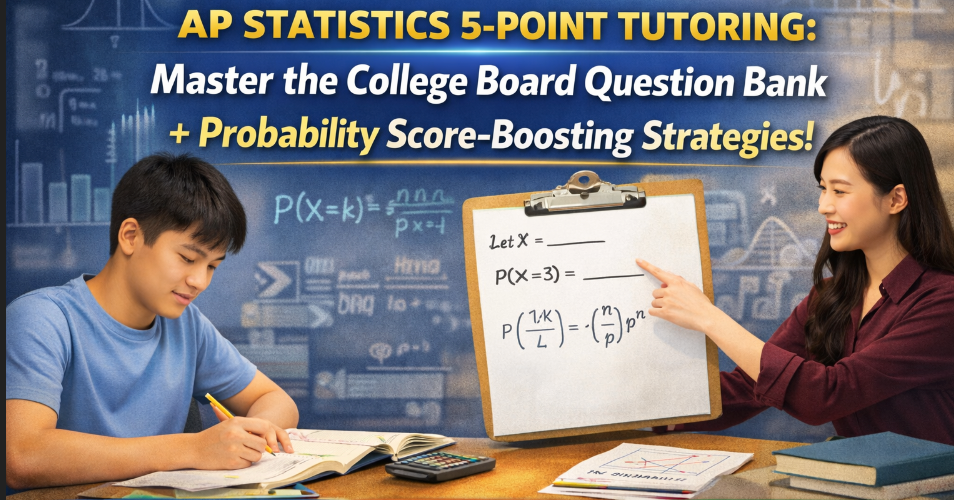
If you ask AP Statistics students what scares them the most, many won’t say hypothesis testing.
They’ll say probability.
Conditional probability.
Random variables.
Binomial vs. geometric confusion.
And those long word problems that look simple—but somehow always lead to the wrong answer.
The truth? AP Statistics is not just about formulas. It’s about understanding how the College Board designs traps.
At **Beijing Sinica Education Technology Co., Ltd. (Sinica Education Inc.)**, we’ve worked with hundreds of AP Stats students. And one pattern is clear:
Students who consistently score 5 don’t just “practice a lot.”
They practice the *right way*—especially with official College Board materials.
Let me tell you about Daniel.
---
## Case Study: Daniel – From 4 Plateau to 5 Breakthrough
Daniel was a strong math student in Grade 11. He handled algebra and calculus smoothly. So he assumed AP Statistics would be easy.
At first, things seemed fine. His multiple-choice scores hovered around 70–75%. But his FRQs—especially probability-based questions—were unpredictable.
Sometimes he forgot to define random variables.
Sometimes he mixed up independent events.
Sometimes he skipped interpretation.
When he joined the 1-on-1 AP Statistics tutoring program at Sinica Education, our first step wasn’t more worksheets.
It was a full diagnostic using official College Board past questions.
And that changed everything.
---
## Why the Official College Board Question Bank Matters
Many students use third-party practice books. They’re helpful—but they don’t always match real scoring logic.
At Sinica Education, we build our AP Statistics training around:
* Official released FRQs
* Real scoring guidelines
* Chief Reader commentary
Daniel quickly realized something important:
AP Statistics grading is extremely structured.
You don’t get points for being “almost right.”
You get points for checking specific boxes.
For example, in a probability FRQ:
* Define the random variable
* State the distribution (binomial? normal? geometric?)
* Verify conditions
* Show formula
* Calculate correctly
* Interpret in context
Miss one step? You lose a point.
---
## The 3 Most Common Probability Mistakes (And How We Fix Them)
After years of tutoring, we’ve identified three major weak spots.
### 1️⃣ Not Defining the Random Variable
This sounds minor—but it’s one of the most common point losses.
Students jump straight into calculation:
> P(X ≥ 3) = …
But never state what X represents.
At Sinica Education, we drill this habit:
Start every probability solution with:
> “Let X = the number of…”
It feels repetitive. But it secures easy points.
Daniel alone gained 2–3 points per exam just by fixing this.
---
### 2️⃣ Confusing Distributions
Is it binomial?
Is it geometric?
Is normal approximation allowed?
Under pressure, students guess.
We teach a simple decision framework:
* Fixed number of trials? → Think binomial.
* Waiting for first success? → Geometric.
* Large sample size + normal conditions met? → Normal model.
Instead of memorizing blindly, students learn to diagnose the structure of the problem.
This reduces careless mistakes dramatically.
---
### 3️⃣ Weak Interpretation
AP Statistics loves contextual answers.
It’s not enough to compute:
> The probability is 0.032.
You must say:
> There is a 3.2% chance that…
And connect it back to the situation.
During Daniel’s tutoring sessions, we practiced writing one-sentence interpretations after every calculation. It became automatic.
That’s what separates a 4 from a 5.
---
## The Sinica Education 6-Week AP Stats Upgrade Plan
Our AP Statistics tutoring program focuses on two parallel tracks:
### Track 1: Concept Mastery
* Sampling distributions
* Inference procedures
* Confidence intervals
* Hypothesis testing
Each concept is tied directly to official scoring examples.
### Track 2: FRQ Precision Training
* Timed probability drills
* Official rubric simulation grading
* Error categorization
* Pattern analysis
After each practice session, we break mistakes into categories:
* Concept misunderstanding
* Distribution misidentification
* Setup error
* Interpretation weakness
This data-driven feedback system is a core strength of Sinica Education.
Our mentor team includes over 100 top North American university graduates, with more than half holding advanced degrees. Many have extensive experience teaching AP curricula and understanding real grading standards—not just theory.
---
## Daniel’s Final Outcome
After six weeks of focused probability and FRQ training:
* His multiple-choice accuracy rose to 85%
* His FRQs became structured and concise
* He stopped losing “easy setup points”
On his final full mock exam, he scored solidly within the 5 range.
When AP scores were released, he earned a 5.
His reflection?
> “Statistics isn’t about being good at math. It’s about being careful and systematic.”
Exactly.
---
## Final Thoughts: AP Statistics Rewards Discipline
AP Statistics is unique.
It’s not as calculation-heavy as calculus.
It’s not as memorization-heavy as history.
It rewards:
* Clear structure
* Precise wording
* Methodical setup
If you’re stuck at a 4, chances are you don’t need to relearn the whole course.
You need to:
* Practice with official College Board questions
* Understand scoring logic
* Fix probability habits
* Build interpretation discipline
And once you do that, a 5 becomes realistic—not lucky.
Because in AP Statistics, points aren’t hidden.
You just have to know exactly where they are—and claim them.