
Connecting You to the Latest News,
Study Tips, and Academic Resources
Every year around March and April, we start hearing the same sentence from students:
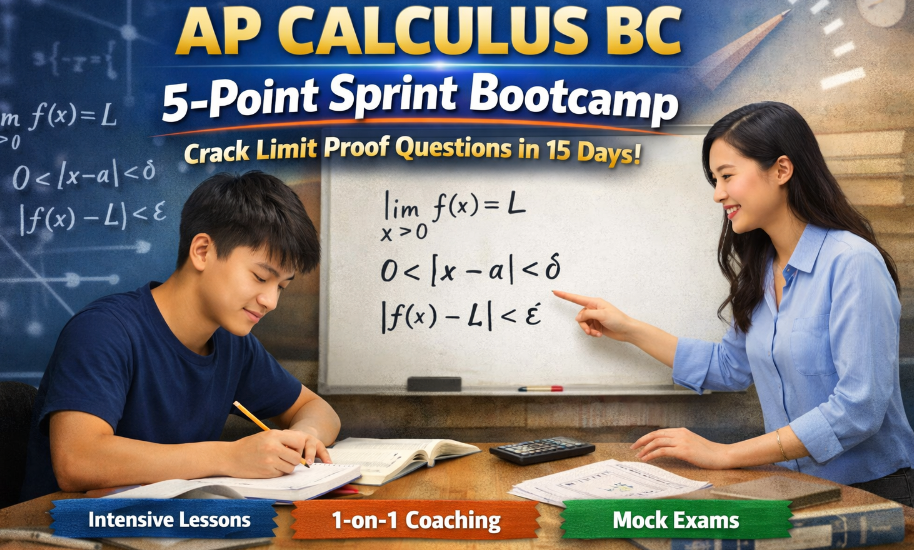
“Derivatives are fine. Integrals are okay. But limit proof questions? I panic.”
If you’re preparing for AP Calculus BC, you already know this isn’t just about plugging numbers into formulas. When it comes to limit proofs—especially those using the formal definition or tricky algebraic manipulation—many students freeze. And unfortunately, these questions often separate a 4 from a 5.
So how do you break through in just 15 days?
At Beijing Sinica Education Technology Co., Ltd. (Sinica Education Inc.), we’ve seen it happen again and again. With the right structure, targeted drills, and 1-on-1 strategy adjustment, limit proof questions can shift from “nightmare” to “guaranteed points.”
Let me tell you about Ethan.
From “I Kind of Get It” to Full Marks on Proofs
Ethan was a Grade 11 student aiming for a 5 on AP Calculus BC. His computational skills were solid—he could handle series, parametric equations, even polar functions. But whenever we gave him a limit proof problem, especially epsilon-delta style or rigorous justification questions, his answers were vague.
He would write things like:
“Since the function approaches 2, the limit is 2.”
Technically not wrong—but absolutely not enough for College Board standards.
After his first diagnostic session with our mentor (an Ivy League graduate with years of AP teaching experience), we identified three core problems:
He memorized steps without understanding the logic.
He couldn’t translate intuition into formal mathematical language.
He lacked exposure to structured proof templates.
Instead of overwhelming him with more worksheets, we built a 15-day micro-plan.
The 15-Day Limit Proof Breakthrough Plan
Here’s how we structured it.
Days 1–3: Rebuilding the Foundation
We didn’t jump straight into full epsilon-delta proofs. First, we clarified:
What does a limit really mean?
How do inequalities behave under transformations?
How to control expressions with algebraic bounding techniques?
Our mentor used visual explanations and real exam samples. We broke down official AP scoring rubrics so Ethan could see exactly how points were awarded.
This alone reduced his anxiety by 50%.
Days 4–7: The “Proof Template” Strategy
Most students think proof questions require creativity. In reality, 80% follow patterns.
We taught Ethan three high-frequency structures:
Direct epsilon-delta manipulation
Using algebraic factorization to simplify expressions
Bounding tricky expressions with inequalities
We practiced each structure repeatedly—but with increasing difficulty. Every session ended with a timed mini-test, simulating exam pressure.
By Day 7, Ethan could complete a standard limit proof question independently.
Days 8–11: AP-Level Trap Questions
This is where students aiming for 5 must level up.
We introduced:
Piecewise function limits
Proofs involving trigonometric expressions
Justification questions in free-response format
Our mentors at Sinica Education Inc. are trained not just to teach solutions—but to teach scoring logic. Ethan learned how to phrase statements like:
“Given ε > 0, choose δ = …”
“Therefore, by the definition of limit…”
Small wording adjustments made a huge difference in clarity.
Days 12–14: Speed + Accuracy Integration
Getting it right isn’t enough. On the AP exam, time pressure is real.
We combined:
Timed free-response sections
Error pattern analysis
Personalized feedback after every attempt
One thing we emphasize at Sinica Education is data tracking. After each practice session, Ethan’s mistakes were categorized:
Concept misunderstanding
Algebraic slip
Logical gap
Instead of repeating all questions, we targeted only weak spots.
Efficiency matters when you only have 15 days.
Day 15: Mock Exam Simulation
On the final day, Ethan completed a full BC free-response section under exam conditions.
Result?
Full credit on the limit proof question.
Two months later, he received his AP score: 5.
Why 1-on-1 Coaching Makes the Difference
You might ask: Can’t students just watch videos online?
The problem isn’t information. It’s personalization.
At Beijing Sinica Education Technology Co., Ltd. (Sinica Education Inc.), our mentors don’t use generic lesson plans. Each student receives:
A diagnostic skill assessment
Customized topic prioritization
Real AP-style scoring breakdown
Weekly performance tracking
Our mentor team includes over 100 top North American university graduates, with more than half holding advanced degrees. Many have taught AP courses in U.S. private schools, so they understand how AP readers actually grade responses.
That insider perspective changes everything.
What Students Realize After 15 Days
By the end of the bootcamp, students often say:
“I thought proofs were about being smart. Turns out they’re about being systematic.”
Limit proof questions test clarity, structure, and discipline—not genius.
If your goal is a 5 on AP Calculus BC, you can’t afford to ignore this section. It’s one of the cleanest ways to secure high-difficulty points that many students give up on.
And sometimes, all it takes is 15 focused days—with the right mentor guiding every step.
AP Calculus BC isn’t just about surviving derivatives and integrals. It’s about mastering the logic behind them.
If you’re staring at a limit proof problem right now thinking, “I have no idea where to start,” remember Ethan.
Two weeks later, he did.
And so can you